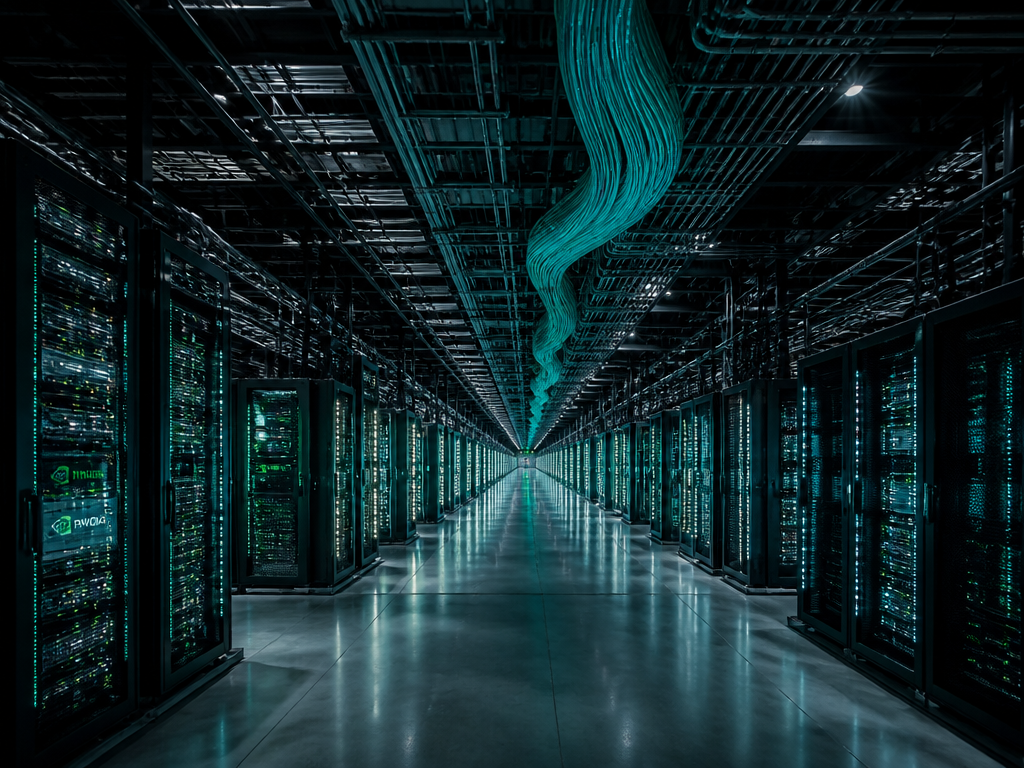
You've watched Anthropic sign cloud commitments that read like national infrastructure budgets — a multi-year arrangement with Amazon reported in the tens of billions, deepening tie-ups with Google Cloud, hardware roadmaps spanning two chip ecosystems at once. And then, in the same news cycle, you read that the company is scouting its own data center leases at gigawatt scale. So the obvious question, the one most coverage skips past: if the Anthropic infrastructure strategy already rents more compute than most countries generate, why would it start building?
I think the contradiction is the most interesting thing on the table right now, and I think most of the people writing about it have resolved it too quickly in one direction — either "Anthropic is going independent" or "this is just more capex theater." Neither is right. The honest answer takes a little longer, and it changes how you should read every infrastructure announcement that follows.
What renting compute actually buys you — and what it quietly doesn't
Here is the plain-language version, because the rest of this piece depends on it. An AI lab training and serving frontier models needs three things from its compute, and they are not the same thing:
- Capacity — enough accelerators, power, and networking to train the next model and serve the last one, available on the dates you need them.
- Cost predictability — a unit economics curve you can forecast, because inference is a per-token business and a few cents of margin compound across billions of calls.
- Control — the ability to decide what gets built, where, on what timeline, optimized for your specific workloads rather than a general tenant population.
A cloud contract delivers the first one beautifully and the third one barely at all. When you rent from a hyperscaler, you are buying guaranteed access to capacity that someone else designed, financed, and operates. That is enormously valuable when capacity is the binding constraint — and for the last few years, capacity has been the binding constraint for every serious lab. You take the deal because the alternative is not having the chips.
What renting doesn't buy you is the marginal unit. When demand spikes past your committed reservation, you are in the same queue as everyone else, negotiating against your own landlord. When you want a data center laid out for a specific training topology, you are asking a vendor to change their roadmap for you. And the cost curve is theirs to bend, not yours. That gap — between the capacity you've secured and the control you haven't — is the entire reason a company that has already committed enormous sums to the cloud would also start signing leases of its own.
Rent, build, or both: comparing the three models honestly
There are really three postures an AI lab can take toward compute, and it's worth laying them against each other with named criteria rather than asserting which one wins.
The pure-tenant model. You commit to one or two hyperscalers, sign multi-year capacity reservations, and let them carry the capital risk of the buildings, the power contracts, and the depreciation. This is where most labs started, because it's the only posture available when you have model demand but not a balance sheet that can absorb data center construction.
The direct-lease model. Here you go to the developers and operators yourself — leasing or co-developing facilities, contracting power directly, specifying the build. You're not necessarily pouring concrete with your own crews; "build" in this context often means long-term leases on purpose-built capacity, with you as the named tenant shaping the design. The capital intensity is real, and so is the control.
The hybrid. You do both at once, on different time horizons, and you treat the cloud deals and the direct leases as hedges against different risks rather than as competing bets. This is, as far as I can tell, where Anthropic actually is — and where OpenAI, in its own way through different partners, has landed too.
Let me run these against the criteria.
Cost curve
Renting gives you a known price for a known commitment, but the hyperscaler keeps the spread between what it costs them to operate a facility and what they charge you. At small and medium scale, that spread is the price of not carrying risk, and it's worth paying. At the scale Anthropic now operates, the spread becomes a structural tax on every token served. Direct leasing lets you capture more of that spread — you take on the financing and operational risk, and in exchange the long-run per-unit cost bends toward your favor. The verdict here isn't subtle: above a certain volume, owning the cost curve beats renting it, which is exactly why the build conversation starts only after a lab gets very large.

Capacity guarantee
This one cuts the other way. A signed cloud reservation is a contractual capacity guarantee backed by a company that already operates the buildings. A direct-lease pipeline is a series of agreements, some preliminary, that resolve into power and racks over years, not weeks. If your single biggest fear is being short of compute during the next training run, the cloud deal is the surer thing. Building your own capacity does not help you in the next two quarters; it helps you in the next four years. So if you're trying to understand why the AWS-scale commitments don't go away when the leasing starts, this is half the answer — they're solving for different timeframes.
Strategic independence
Renting concentrates a dependency. When one provider supplies most of your compute, that provider has leverage over your roadmap, your pricing, and — uncomfortably — your competitive position, since the largest cloud providers are also building their own models. Direct leasing diffuses that dependency. It doesn't eliminate it; you still depend on power utilities, chip vendors, and developers. But it moves the bottleneck away from a single counterparty who is also, in some markets, a rival. For a lab whose entire value is the model, reducing the number of throats it can be choked by is not paranoia. It's hygiene.
Balance-sheet optics
Here is where investors and reporters tend to get the story backwards. Renting keeps capex off your books and shows up as operating commitments — cleaner for a company that wants to look asset-light heading toward public markets. Direct leasing and co-development load up obligations that a skeptical analyst will scrutinize hard. So on pure optics, renting wins. The reason a maturing lab takes on the heavier posture anyway is that owning the cost curve and the capacity destiny is worth looking more capital-intensive — provided someone else helps carry the financing. Which brings in the part everyone fixates on.
Speed and financing
A cloud deal is fast: sign, provision, train. A direct build is slow and expensive, and the only way a company that isn't yet generating hyperscaler-level cash flow can attempt it is with a backer willing to underwrite the capital. That is the role Google has been playing — not merely as a cloud vendor but as an investor whose money helps make the leasing pipeline financeable. When a major shareholder is also a compute supplier and also a financier of your independent capacity, the relationships stop being clean categories and start being a web. The "build your own" move is, paradoxically, often funded by the same giants you're trying to depend on less.
Put the criteria together and a verdict emerges without my having to announce it: at Anthropic's scale, the pure-tenant model can't hold, because the cost curve and the concentration risk both work against you. The pure-build model can't hold either, because it's too slow to cover near-term capacity and too heavy to finance alone. The hybrid isn't a compromise between two strategies. It's the only one that survives contact with the numbers.
Why the cloud deals and the data center hunt are both true at once
The instinct when you read "Anthropic commits tens of billions to AWS" and then "Anthropic scouts gigawatt-scale leases" is to assume one of them is the real strategy and the other is noise — or that the second supersedes the first. It doesn't. The cleanest way I've found to hold both in mind is this: the cloud deals secure the compute Anthropic needs now, and the leasing pipeline secures the compute it will need at the margin later.
Think about what's actually being hedged in each case.
The cloud commitments hedge against the near-term capacity crunch. If the next model needs an enormous, coordinated training run in the next year, you cannot wait for a data center to be energized. You need racks that exist today, operated by someone who has done it at scale. The hyperscaler relationships also bring chip access — Anthropic's roadmap spans Amazon's Trainium silicon and Google's TPUs, which is a deliberate bet on not being captive to a single accelerator supply. That diversity is itself a form of independence purchased through, not against, the cloud relationships.
The direct leasing hedges against the long-term structural problem: that renting the marginal unit of compute from a vendor who is also a competitor, on a cost curve you don't control, doesn't scale to where inference demand is heading. If Anthropic believes its own demand forecasts — and the entire build-out is an expression of that belief — then the question is not whether it will need more compute than its cloud contracts cover, but how much more, and who will own the buildings that supply it.

So the contracts aren't in tension. They're stacked. The cloud deals are the floor under current operations; the leases are the company reaching for control over the part of the demand curve that the contracts were never going to cover cheaply enough. A reader who treats these as contradictory will misread every future announcement. A reader who treats them as two layers of the same plan will see the shape of it.
What this signals to the people watching the money
If you cover this sector or invest in it, the build-out is less interesting as a logistics story than as a signal, and there are a few worth separating.
Maturation. Renting all your compute is what a startup does. Carrying capacity obligations and shaping data center design is what an infrastructure company does. The shift in posture is a tell that Anthropic now models itself as a long-lived operator of compute, not just a consumer of it — and that's the kind of self-conception that precedes public-market scrutiny. Heavier obligations are a strange flex, but they read as confidence in demand durability.
Supplier-power dynamics. Watch what direct leasing does to the negotiating table. A lab that can credibly source its own capacity negotiates with hyperscalers from a different position than one that can't. Even a modest owned-and-leased base changes the leverage in the next cloud renewal. The build-out's value is partly the capacity itself and partly the bargaining posture it creates.
The financing web. The single most important thing to track is who funds the independent capacity. When the same firm appears as investor, cloud supplier, and backer of your direct leases, "independence" gets complicated. The arrangement can reduce dependence on one axis while deepening it on another. Don't take the word "independent" at face value; trace the capital.
Power, not chips, as the constraint. Gigawatt-scale leasing is fundamentally a bet on electricity and interconnection, not just accelerators. The binding constraint for the next phase of expansion is increasingly the ability to energize a site — utility timelines, grid capacity, power-purchase agreements. When you see a lab signing for capacity in specific regions, read it as a statement about where power is available and cheap, which is a different map than where talent or customers are.
A reader's table: what each posture optimizes for
| Criterion | Pure tenant (rent) | Direct lease (build) | Hybrid (both) |
|---|---|---|---|
| Near-term capacity | Strongest | Weak | Strong |
| Long-run cost per unit | Worst | Best | Improving |
| Independence from rivals | Lowest | Higher | Mixed |
| Balance-sheet lightness | Lightest | Heaviest | Heavy |
| Speed to deploy | Fastest | Slowest | Layered |
| Who carries capital risk | Provider | You (+ backer) | Split |
What to watch next
- The ratio, not the headline. Track owned/leased capacity as a share of total committed compute over time. The trajectory of that ratio tells you more than any single deal.
- Who finances the leases. Equity backer, debt, or vendor financing — each implies a different degree of real independence.
- Region and power. Where the sites are reveals the actual constraint. Follow the megawatts and the utility agreements.
- Renewal terms. The next cloud-contract renewal will quietly price in whatever leverage the build-out has created. Read the structure, not the dollar figure.
- Chip diversity. Continued multi-silicon commitments are a hedge against accelerator-supply capture; concentration would be the more worrying signal.
The verdict that emerges
When you run the comparison all the way through, the build-out stops looking like a pivot away from the cloud and starts looking like the predictable next move of a company that got large enough for the cost curve and the concentration risk to matter more than the convenience of renting. The cloud deals never stop being necessary. The leases were never going to be optional.
What Anthropic is really buying with the direct-leasing pipeline isn't independence as a slogan — it's control over the marginal unit of compute, the capacity that sits beyond what any reasonable cloud reservation would cover at a price that works. That's the asset that determines whether a frontier lab can keep serving demand profitably as that demand compounds. Everything else — the optics, the partnerships, the financing web — is downstream of that one question: who owns the next megawatt when you need it.
If you're trying to make sense of the next infrastructure announcement tonight, use this: when a lab both rents and builds, don't ask which one is the real strategy — ask which time horizon each one is solving for, and the contradiction disappears.