There is a number that gets quoted in almost every story about Gulf money and artificial intelligence: forty billion dollars. It is the headline size of a sovereign-vehicle commitment to AI infrastructure, and it is the kind of figure that makes a fund manager sit up. It is also, on its own, close to useless for understanding what sovereign wealth funds are actually doing right now.
I have spent the better part of a year reading the same coverage you have — energy desks writing about Gulf renewables, tech desks writing about data-center buildouts, and almost nobody writing about the thing that connects them. The forty-billion number is real. What it measures, and what it conspicuously fails to measure, is the whole story.
What the number actually measured
Forty billion is committed capital — a stated intention to deploy into compute, data centers, and the surrounding stack over a multi-year horizon. That is a measure of appetite. It tells you a state-backed fund has decided that AI infrastructure is a strategic asset class on par with the energy and equity holdings that built its balance sheet.
What it does not measure is deployable capital under current conditions. And in 2023 and 2024, the gap between those two things became the entire game.
The reason is export controls. When the United States tightened restrictions on advanced semiconductors and the equipment that makes them, and then extended scrutiny to who could buy and operate large clusters of high-end accelerators, capital stopped being the scarce input. You can announce forty billion. You cannot announce your way into a few hundred thousand top-tier chips if the licensing regime, the end-use rules, and the diplomatic relationship are not aligned. The binding constraint moved. The money was waiting on something money could not buy directly.
This is the part fragmented coverage misses. A headline of "$40B AI fund" reads as a capital story. It is actually a regulatory-access story wearing a capital story's clothes.
How does AI regulation affect sovereign wealth funds?
In plain terms: export controls have turned chip access — not capital — into the scarce resource, so the largest state-backed investors are now competing on regulatory standing and trusted-partner status rather than on check size alone. A fund's ability to deploy into AI infrastructure increasingly depends on which jurisdiction's rules govern the hardware, where the data center physically sits, and whether the fund's home government is treated as a security partner or a security risk.
That single shift reorganizes how these institutions think. The classic model treated a fund as a price-taker allocating across assets. The new model treats it as a party that has to qualify — to satisfy end-use conditions, ownership-disclosure requirements, and sometimes to restructure so that the controlling entity is acceptable to the regulator who holds the keys to the supply chain. The capital was never the question. The question is whether you are allowed to spend it on the only inputs that matter.
You can see this in the deals that worked. The ones that closed were not the biggest announcements. They were the ones where the fund had already done the diplomatic work — security assurances, governance changes, sometimes a U.S. or allied co-investor stapled in as a credibility anchor. The structure was designed around the rules first and the returns second. That ordering is new, and it is the tell.
The constraint cuts across three domains at once
Here is why energy coverage and tech coverage both fail you when read separately. A modern AI buildout is not one asset. It is three overlapping ones, and regulation reaches into all three.
The first is compute — the chips, the networking gear, the fabrication tools. This is where export controls bite most directly, with named entity lists and license requirements that change which hardware can land where.

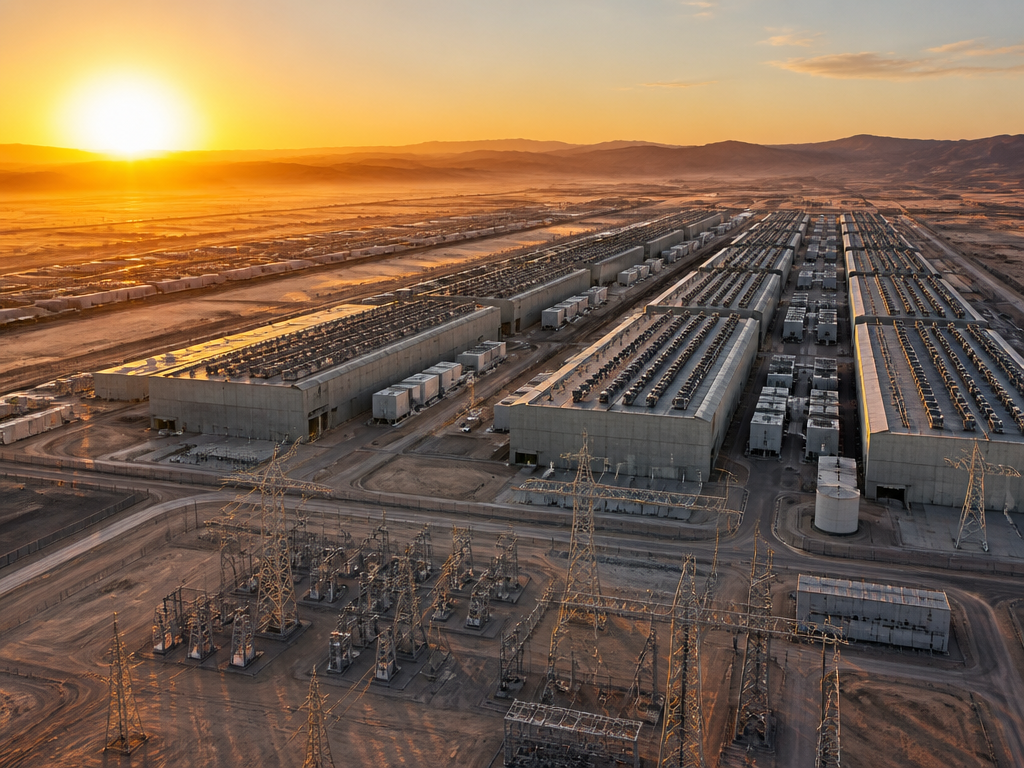
The second is energy — the power, the cooling, the grid connections. A large cluster is a heavy industrial load. Gulf funds in particular hold a genuine structural advantage here: cheap, abundant power and land. That advantage is exactly why they entered, and it is also why the compute constraint frustrates them so visibly. They have the hard part of the physical stack and are blocked on the part that ships in a crate.
The third is jurisdiction — where the facility legally lives, whose data-residency and national-security rules apply, who can audit it. This is the domain that most investors treat as paperwork and that now functions as the actual gate.
The reason a state-backed fund is structurally suited to this is that it can move across all three at once. A private buyer optimizes for return inside one domain. A sovereign vehicle can build the power plant, finance the data center, and negotiate the diplomatic terms as a single coordinated act, because the same institution touches energy policy, capital allocation, and statecraft. That coordination is the product. The forty-billion number is just its down payment.
Cheaper power lowers the cost of running AI. More AI capacity raises the strategic value of cheap power. The two reinforce each other — which is precisely why treating them as separate beats produces incoherent analysis.
What the number does not measure
The slow, unglamorous overhead is invisible in any dollar figure. Becoming a trusted entity — the standing that lets you actually buy and operate restricted hardware — is a multi-year relationship, not a transaction. It involves divesting or ring-fencing holdings that look hostile to a regulator, accepting monitoring, sometimes accepting partial control by an allied co-investor. Funds have quietly reshaped governance to qualify. None of that shows up as a press release with a number attached.
It also does not measure reversibility. A licensing regime can tighten again. A diplomatic relationship can cool. The asset you bought to be strategic can become stranded if the rules that made it usable change. That tail risk is real and is priced almost nowhere in the public commentary, because the public commentary is still reading the headline as a capital story.
So when you see the next nine- or ten-figure AI commitment from a sovereign vehicle, the useful questions are not about size. They are: under whose export rules does this operate, where does the hardware physically clear, and what did the fund have to become to be allowed to spend the money.
A small map you can use
Here is the constraint stack in the order that now matters — top to bottom, scarcest to most abundant:
| Layer | What's scarce | Who controls it | SWF advantage? |
|---|---|---|---|
| Compute (chips, tools) | Access, not money | Export-control regime | Weak — must qualify |
| Jurisdiction (siting, audit) | Trusted standing | Home + host governments | Mixed — diplomatic |
| Energy (power, land) | Genuinely scarce elsewhere | Domestic policy | Strong |
| Capital | Not scarce here | The fund itself | Strongest, least decisive |
Read top-down, the picture is clear: the fund's traditional strength sits at the bottom of the stack, and the binding constraint sits at the top.
Try this this week
Take one sovereign-fund AI announcement from the last twelve months. Find the dollar figure everyone quoted. Then spend twenty minutes finding the export-licensing or jurisdictional condition attached to it — the co-investor, the siting, the governance change. If you can't find one, that tells you the deal is still an intention. If you can, you've found the part that actually determines whether the money moves.
The size of the check tells you what a sovereign fund wants. The rules tell you what it can have — and right now the rules are doing the deciding.